News articles
NEXTAIR Final Meeting
The NEXTAIR project has reached its end!
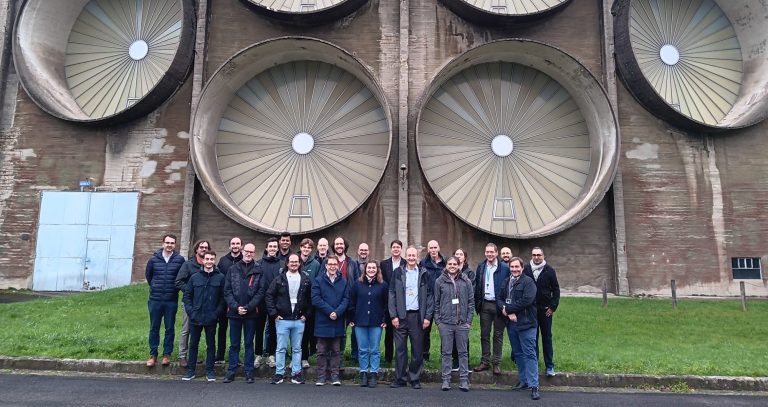
Our Final Meeting took place on 10 and 11 December 2025 and was hosted by ONERA officer in Meudon, France. It was a pleasure for partners to meet again and to immerse in fruitful discussions!
Over a period of three and a half years, ONERA successfully led and coordinated the European project NEXTAIR (Multi-disciplinary Digital Enablers for Next-Generation Aircraft Design and Operations). The project drew on the consortium's expertise in aerodynamics and numerical simulation to address some of the most critical challenges facing the aeronautics sector.
NEXTAIR focused in particular on reducing the environmental impact of aviation and on the development of new aircraft configurations and disruptive propulsion systems, including high-aspect-ratio wings and ultra-high-bypass, non-ducted engines.
The project’s main objectives were to advance the use of high-fidelity, multidisciplinary and robust optimisation techniques, as well as to apply fast-response simulation technologies for design support and diagnostics. These technologies, based on machine learning and artificial intelligence, were applied to the design of new civil aircraft configurations—such as aircraft wings, engine integration, and engine components—as well as to maintenance activities.
The NEXTAIR project ran for 40 months, from September 2022 to December 2025, and received €4.7 million in funding under the Horizon Europe programme.
NEXTAIR - webinar for SMEs - GEMSEO tool
On 6 November 2025, the NEXTAIR project hosted an online webinar dedicated to advanced design tools for next-generation aircraft and engine development.
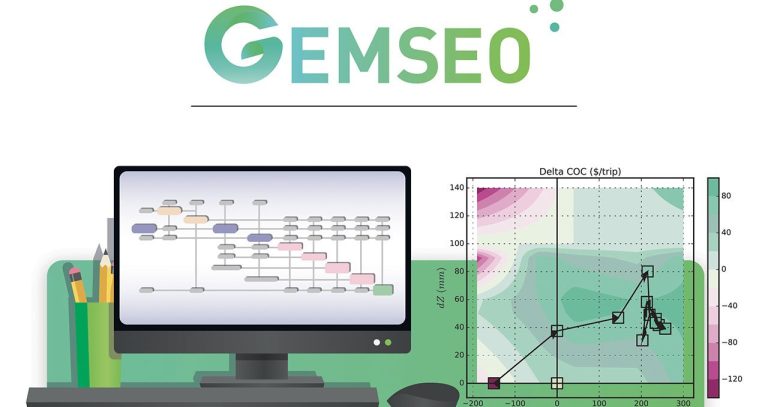
The event provided participants with in-depth insights into GEMSEO, an open-source software developed by IRT Saint Exupéry and a core component of the NEXTAIR multidisciplinary design ecosystem.
During the three-hour session, GEMSEO was presented as a key enabler for multidisciplinary design, optimisation, and uncertainty quantification in complex aerospace engineering systems. Speakers demonstrated how the software supports the design of aircraft and propulsion systems by integrating high-fidelity simulation capabilities within a unified digital framework.
The webinar featured contributions from GEMSEO developers as well as industrial end-users, who shared practical feedback on the tool’s application in real-world engineering contexts. Discussions also highlighted GEMSEO’s role within NEXTAIR in advancing more sustainable and efficient approaches to aircraft and engine design.
Held online via Microsoft Teams, the event brought together members of the NEXTAIR community and a broader audience interested in digital engineering methods for future aerospace systems.
NEXTAIR Final Event to take place at the 4th European Workshop on MDO for Aeronautics
We are pleased to announce that the Final Event of the NEXTAIR project will be held during the 4th European Workshop on Multidisciplinary Design Optimisation (MDO) for Industrial Applications in Aeronautics, taking place from 3rd to 5th June 2025 at ISAE-SUPAERO in Toulouse, France.
This event gathers leading experts from industry, academia, and research to explore advancements in MDO methodologies and their application to real-world aeronautical challenges. Hosting our Final Event within this dynamic context offers a unique opportunity to connect, share, and reflect on our achievements.
📍 Where? ISAE-SUPAERO, Toulouse, France
📅 When? 5th June 2025
🎯 What? Presentation of NEXTAIR final results, key insights from partners, and engaging discussion with the MDO community.
Please note that places are limited, and registration is only open until 12th May 2025. We encourage all interested participants to register early to secure their spot.
🔗 Learn more and register: https://events.isae.fr/event/40/
5th NEXTAIR Steering Committee
The NEXTAIR project has entered its final year!
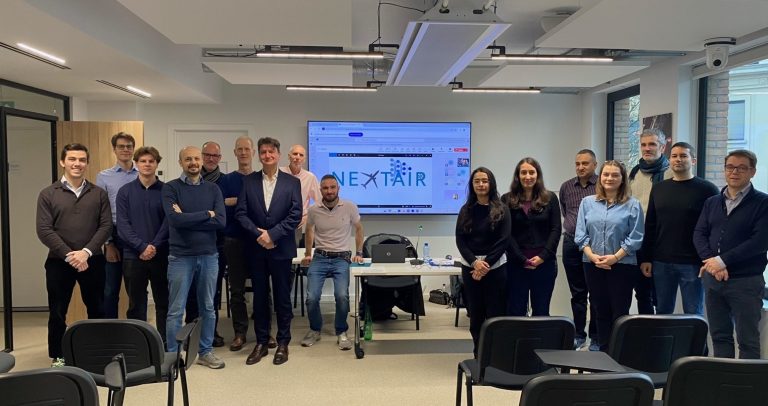
Our 5th Steering Committee took place on 5th and 6th February 2025 and was hosted by the ONERA officer in Brussels, Belgium. It was a pleasure for partners to meet again and to immerse in fruitful discussions!
The aim of the meeting was to give an overview of the progress of the project, focusing on the Work Packages (WPs), project management and communication and dissemination activities, as well as to allow the partners to have technical discussions within and between the WPs. The results are very promising, and the WP leaders have discussed how they can better deliver them to the European Commission.
As we are getting closer to the end of the project, the partners discussed and planned the future communication and dissemination activities. The organisation of the final workshop is ongoing, and an SMEs workshop will be planned in the next few months.
The Consortium is due to meet again in July 2025, in Paris, France.
Stay tuned to find out more!
4th NEXTAIR Steering Committee
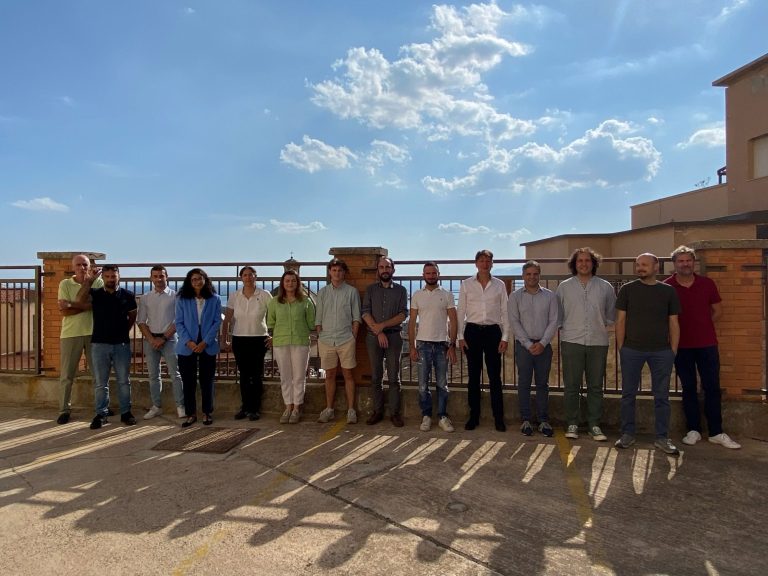
On the 25th and 26th September 2024, NEXTAIR partners had the pleasure to meet in Cagliari, Italy for the 4th Steering Committee on the UNICA premises.
It has been now two years since the project started, a milestone to celebrate.
Work sessions have been organised for each WP and partners had plenty of time to discuss their results and how to plan the project further.
As we are getting closer to the end of the project, the partners discussed and planned the future communication and dissemination activities. The organisation of the final workshop is slowly starting, and SMEs activities will be planned.
Stay tuned to find out more!
Participation to ECCOMAS Conference 2024
Some of our NEXTAIR partners participated at the ECCOMAS Conference on 3 – 7 June, in Lisbon, Portugal. And their participation did not go unnoticed! All abstracts are available below.
CONSISTENT DISCRETIZATION SCHEMES FOR THE CONTINUOUS ADJOINT EQUATIONS IN AERODYNAMIC SHAPE OPTIMIZATION FOR TURBULENT/TRANSITIONAL FLOWS (Dassault Aviation lead).
HIGH-FIDELITY MULTIDISCIPLINARY DESIGN TRADE STUDY OF SHORT-MEDIUM RANGE AIRCRAFT WITH HIGH ASPECT-RATIO WING (DLR and AIRBUS lead).
MACHINE LEARNING-BASED SURROGATES FOR UNCERTAINTY QUANTIFICATION AND DESIGN UNDER UNCERTAINTIES (FOSS and NTUA lead).
SAMPLING AND ESTIMATING THE SET OF PARETO OPTIMAL SOLUTIONS IN STOCHASTIC MULTI-OBJECTIVE OPTIMIZATION (INRIA lead).
ADVANCED MDO AND ROBUST OPTIMIZATION WITH GEMSEO (IRT lead).
CONTINUOUS ADJOINT-BASED OPTIMIZATION OF A HIGH ASPECT-RATIO WING BUSINESS JET IN TRANSITIONAL FLOWS (NTUA lead).
UQ ANALYSIS AND ROBUST OPTIMIZATION OF A TRANSONIC AIRFOIL FOR OPEN ROTOR DESIGN (ONERA and SAFRAN lead).
MULTIDISCIPLINARY AERO-THERMO-STRUCTURAL DESIGN OPTIMIZATION OF A MODERN HIGH-PRESSURE TURBINE ROTOR (UNICA and ROLLS-ROYCE lead).
VG OPTIMIZATION FOR TURBOMACHINERY APPLICATIONS (UNICA and ROLLS-ROYCE lead).
PROGRESS AND ONGOING ACTIVITIES IN THE NEXTAIR PROJECT: AN OVERVIEW (ONERA lead).
3rd NEXTAIR Steering Committee
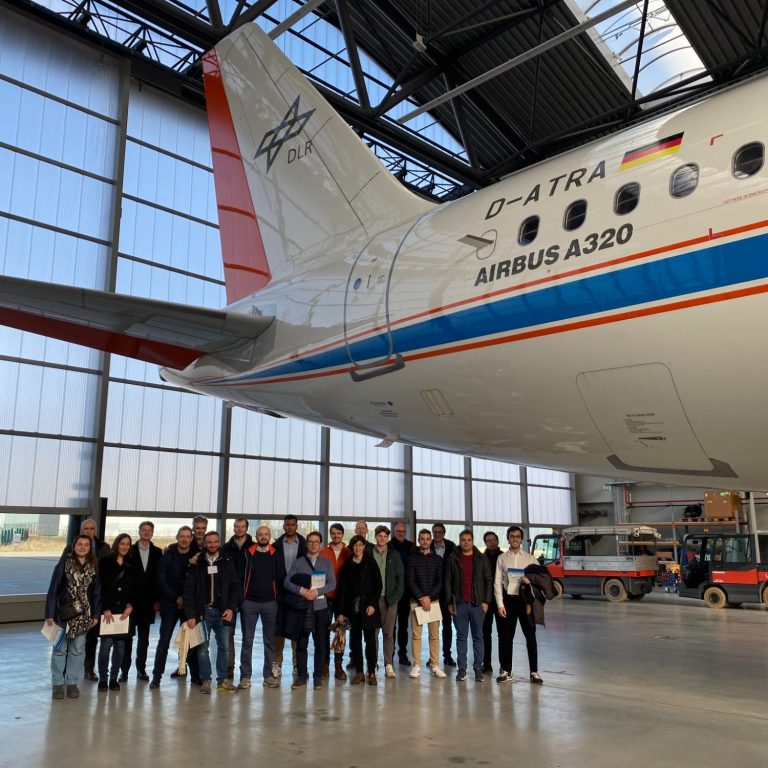
The NEXTAIR project is now half-way through its progress. Our 3rd Steering Commitee took place on 28 and 29 February 2024 was hosted by the German Aerospace Center (DLR) in Braunschweig, Germany. It was a pleasure for partners to meet again and to immerse in fruitful discussions!
The aim of the meeting was to give an overview of the progress of the project, focusing on the Work Packages (WPs), project management and communication and dissemination activities, as well as to allow the partners to have technical discussions within and between the WPs. The results are very promising, and the WP leaders have discussed how they can be better presented during the Review Meeting with the European Commission, which will take place in Brussels on 15 May 2024.
The Consortium had the pleasure to visit DLR's largest research aircraft, the Advanced Technology Research Aircraft (ATRA). This AIRBUS A320 has been in operation since late 2008. The DLR ATRA is a modern and flexible flight test platform which sets a new benchmark for flying test beds in the European aerospace research. A modern research platform for tackling questions concerning aerodynamics, avionics, and engine research, ATRA is the only aircraft of its kind in Europe.
The Consortium is due to meet again in September 2024, in Cagliari, Italy.
Stay tuned to find out more!
2nd NEXTAIR Steering Committee
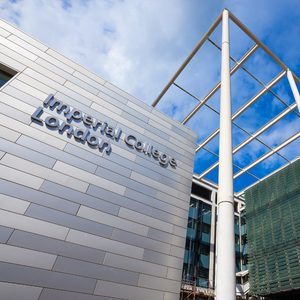
On the 12th and 13th September 2023, NEXTAIR partners had the pleasure to meet in London, United Kingdom for the 2nd Steering Committee on the Imperial College London premises. One year after the project started, it was time to review the progress and to plan the actions for the next year.
Work sessions have been organised for each WP and partners had plenty of time to discuss their results and how to plan the project further.
The project’s first video is getting ready, and partners are looking forward to sharing it with the public and the scientific community.
The first reporting period is fast approaching (February 2024), so for the next six months the Consortium is making sure all milestones are achieved and deliverables submitted.
Stay tunned to find out more!
Participation to EUROGEN Conference 2023
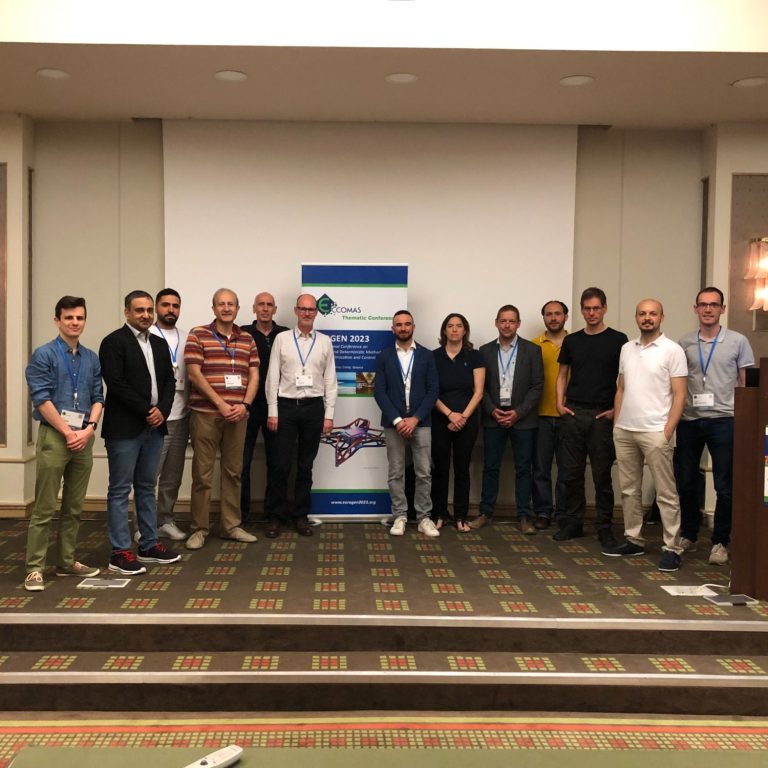
Some of our NEXTAIR partners participated at the EUROGEN Conference on 1 – 3 June, in Crete, Greece. And their participation did not go unnoticed!
NTUA, ONERA (on behalf of the NEXTAIR Consortium) and Dassault Aviation organised the Mini-Symposium on "Adjoint methods, including multi-fidelity approaches for Multi-Disciplinary Optimisation (MDO) in aerospace applications" (Prof. K. Giannakoglou, Dr. M. Carini et Dr. G. Rogé).
The following talks have been presented:
- “Multi-physics simulation and topology optimisation of a heat-exchanger” by Prof. S. Shahpar, Rolls-Royce Fellow. This included promising results on using gyroid shapes to improve the heat-exchanger performance (NEXTAIR TC8).
- “Comparison of efficient Uncertainty Quantification (UQ) techniques on a transonic airfoil using RANS computations and adjoint methods” by Q. Bennehard, Research Engineer at ONERA. This showed an assessment of gradient-enhanced and compressed sensing techniques to reduce the cost of UQ on a transonic airfoil test case with 10 uncertain shape parameters (NEXTAIR DEN3, Efficient UQ Techniques).
- “An adjoint body-force approach for fully coupled aero-propulsive optimizations” by C. Dosne, PhD candidate at ONERA. This illustrated a first application of simplified body-force model and its adjoint in gradient-based optimisation of a two-dimensional distributed propulsion configuration (NEXTAIR DEN1, Advanced digital models for green design).
- “The NEXTAIR project: an overview of challenges and objectives” by Dr. M. Carini, NEXTAIR Coordinator on behalf of ONERA.
- “Application of Aero-Structural Wing Design under High-Fidelity Based Longitudinal Static Stability Constraints” by Dr. M. Abu-Zuryak, DLR. This focused on the integration of Hi-Fi (RANS-based) prediction of longitudinal stability constraint in gradient-based aero-structural wing optimisation (NEXTAIR DEN1, Advanced digital models for green design and relevant for TC1).
- “Towards real-time CFD” by Dr. A. Rao, Imperial College London. This presented results on the use of a Convolution Neural Network (CNN) to predict the flow distortion map at the engine inlet due to vortex-ingestion (NEXTAIR DEN5, ML for fast-performance prediction).
- “Stochastic gradient based Monte Carlo sampling of Pareto optimal solutions” by Z. Jones, PhD candidate[CM4] at INRIA (NEXTAIR DEN2, Numerical and algorithmic speed-up in MDO).
NEXTAIR activities have also been mentioned in the plenary lectures on:
- High-Fidelity Aerodynamic Shape and Multi-Disciplinary Optimisation for Aircraft Design: A Capability Perspective with Applications, given by J. Brezillon, Research Scientist at Flight Physics Capabilities Department of Airbus Operations SAS;
- Role of MDO towards climate-neutral aircraft, given by Dr. M. Méheut, Head of the civil aircraft unit at ONERA;
with focus on high-aspect-ratio aero-structure technology (TC1), Unducted Single Fan engine concept (TC4) and Hi-Fi robust MDO (DEN3).
Stay tunned to find out more!

Funded by the European Union under the GA number: 101056732. Views and opinions expressed are however those of the author(s) only and do not necessarily reflect those of the European Union. Neither the European Union nor the granting authority can be held responsible for them.